

RX-78-2 Gundam –Version OYW

Review by Gunpla Rob
Between Super Robot Wars and Gundam SEED, one might imagine that revisiting classic, less flamboyant designs was a thing of the past. However, it is good to return to the past and revisit a classic design with a new flair of the modern.
Its Name Is Gundam
The RX-78-2 is the first Mobile Suit to wear the Gundam name. By design, the RX-78-2 was an open ended, multipurpose machine that could use an assortment of weaponry and functional tasks. It would also work towards becoming the test bed for future machines such as its descendent the RGM-79 “GM” Mobile Suit. Moreover it would set the benchmark for series to follow, creating one of the most successful anime mecha franchises in history, Mobile Suit Gundam.
Mobile Suit Gundam is set in the first Gundam universe called the “Universal Century.” In the year UC 0079 at the time called the “One Year War,” a war was fought between the Principality of Zeon (leading a rebellion of Earth’s orbiting space colonies, called Sides) and the Earth Federation. Zeon, having declared its independence was the first to introduce Mobile Suit technology with the introduction of the MS-05 Zaku, their front line infantry for the war against the Federation’s limited arsenal of tanks and warplanes. The RX-78-2 was the first machine for the Earth Federation’s “Operation V” produced in secret at the Earth Federation controlled space colony Side 7. It consisted of three machines: the RX-75 Guntank, the RX-77-2 Guncannon, and of course, the RX-78-2 Gundam along with the Space Carrier White Base.
Before Kira Yamato and Heliopolis, there was Amuro Ray and Side 7.
Having learning of the Federation’s Mobile Suit program, Zeon launched an assault on Side 7 to seek out and destroy the “Operation V” prototypes. In the chaos of the assault, the citizens of Side 7 are unwittingly forced on board the new Federation carrier ship White Base. Among them is Amuro Ray, son of the creator of RX-78-2, whose curiosity and love of machines would unwillingly throw him into piloting the same machine his father built, the Gundam. With the Federation forces occupying Side 7 weakened, the Civilian refugees aboard the White Base are forced into becoming the ship’s permanent, active crew. Amuro stayed among them to pilot the RX-78-2, claiming the Mobile Suit as his own personal property. In the beginning, their mission was to deliver the Operation V prototypes to Federation headquarters in Jaburo (located in the South America), but as soon as the order was given did it become clear that this ship and its Mobile Suit were destined to fight until the end of the war.
Version OYW
From the very beginning, Bandai has always had model kits for Gundam. Considering that toys were not as pronounced as they are today (say Masterpiece Optimus Prime compared to G1 Prime), model kits were a readily available solution for the marketable occasion. The RX-78-2 has had models from the very conception of the franchise, quite literally one version for each year and in every one of Bandai’s model classes. There are versions of the Gundam in First Grade, High Grade (first generation), High Grade Universal Century, Master Grade, and Perfect Grade. Version OYW joins the ranks of the many Master Grade forms the RX-78-2 has seen:

Version 1: The first MG, Bandai’s concept for the MG expanding on High Grade ‘Panel markings’ and introducing mechanical components. This mold was used for the RX-78-3 G-3 (Gundam prototype), two promotional “clear types” (one in colors, the other solid), a convention exclusive “Char” edition, a Chromed 20th anniversary (of the RX-78-2) edition, and finally Bandai’s 10th Anniversary (of the Master Grade line) done in ‘Mass Production’ colors.
Version 1.5: The Second RX-78-2, a retooled reinvention of the RX-78-2 with new parts based on the endoskeleton structure from the Perfect Grade. This version was to show off a clean cut version of the design and making a 1/100 scale model based on the Perfect Grade’s design. The changes from the Version 1.0 edition consisted of a pre constructed endoskeleton template for the legs, along with new weapons and body assembly. This mold was used for a convention exclusive in chrome, and a standard release “Char” edition.
Version Ka: Named after Hajime Katoki, this version was based on his interpretation of the RX-78-2. Most of the kit is recycled from the previously released RGM-79 Kai GM Commando kits, but it includes new armor parts to make up for the differences between the Gundam and GM.
“Perfect” Gundam: Based on the full armored Mobile Suit Variation of the RX-78-2 from Plamo Kyo Shiro pulp comics. It is a step backwards with minimal mechanical construction with the premiere focus on the add-on armor. In comparison, this version resembles 1/144 scale HGUC RX-78-2 Gundam more than the other molds.
Version OYW, or Version One-Year-War was released initially as a tie-in for the Mobile Suit Gundam -The One Year War- video game. Although typical promotions would include just another remold of a previous RX-78-2 kit, Bandai went to greater lengths to make a new model for the occasion. The end result is one of the best versions of the RX-78-2 they have ever created. Focusing on creating a ‘game accurate’ edition and showing off advancements in Master Grade designs, proving that no matter how old the design may be it still has plenty more to offer.
Tone it Down a Hue
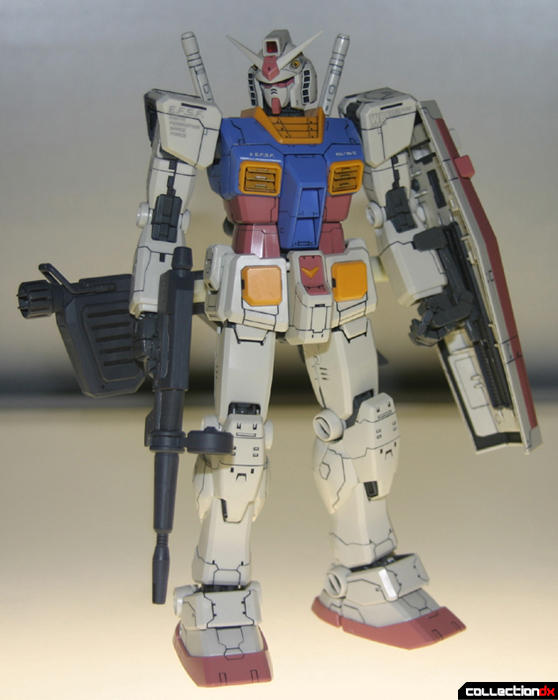
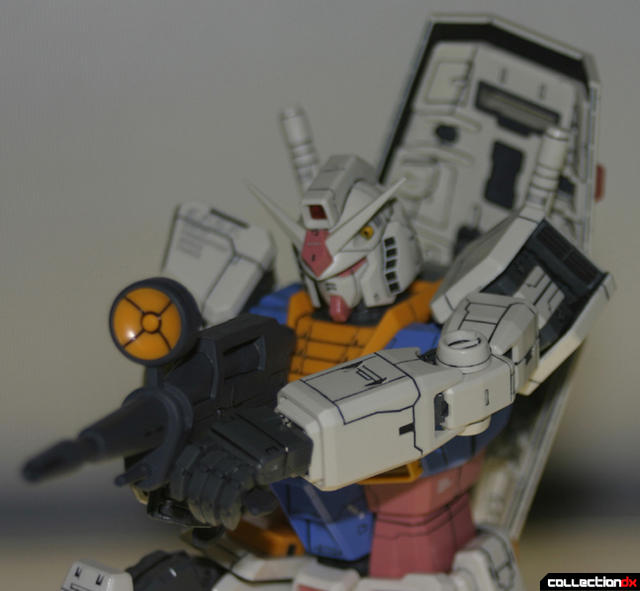
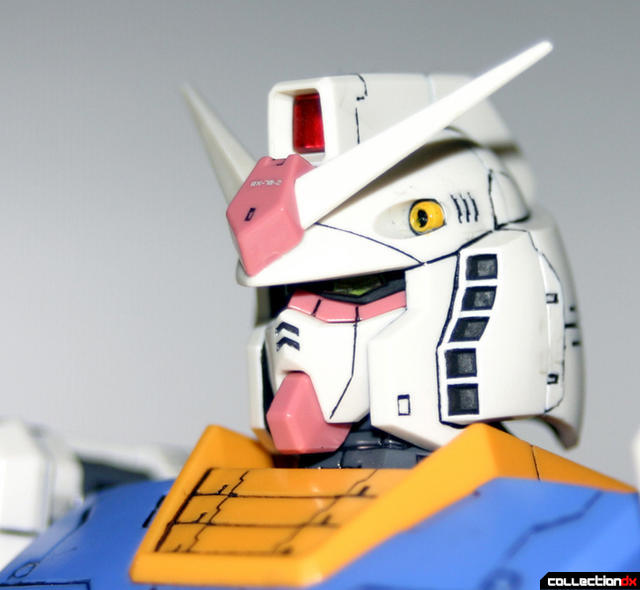
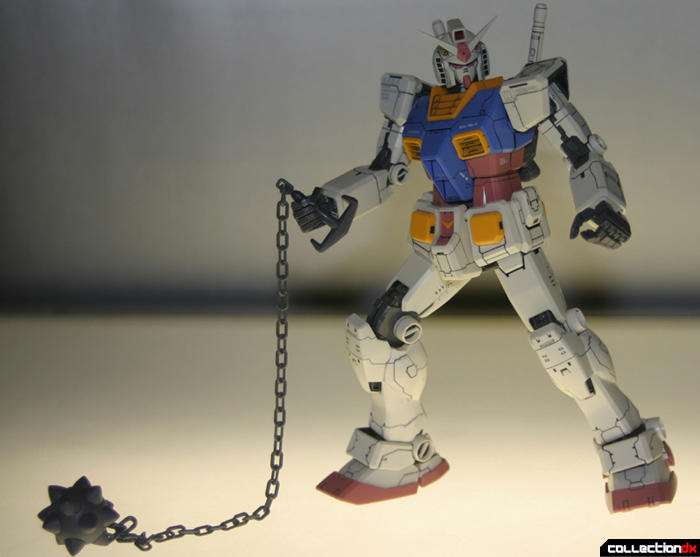
The first edition of Version OYW comes out of the box in a different color scheme than the Gundam is known for. Instead of being in Gundam’s solid primaries of Red, Blue, Yellow, Gray, and White, the colors are much softer, pale colors. The White is more of a sun bleached color, the yellow is a much richer ‘creamy’ yellow (almost like a hint of orange), and the red is very pale, almost pink. While this might put off some builders, this tone of pink is not so bad when executed in moderation. On the other hand, the Infinite Justice Gundam was almost solid pink but was a pretty good kit. The Gray color compared to the others of the kit is the closest to the RX-78-2’s normal tone.
On a side note and as a throw back to my previous breakdown of the RX-78-2’s lifetime in plastic, the Version OYW has already seen a number of remolds in its time of circulation. The first was a convention exclusive in Gundam’s typical primary color scheme in chrome followed closely by its second and most likely expensive “Real Design” exclusive. This version consisted of duplicate runners for the outer body in alternative colors such as black, gray, drab green, and white to create the design in its varied “Mass Production” colors. Finally, there is another version in standard circulation that is in Gundam’s ‘Anime Accurate’ primary colors of red, white, blue, and yellow. Although the exact same kit as the one reviewed here, this one can often be found to be a little expensive due to its more recent release.
Building
Version OYW is almost an entirely new kit, short of borrowing parts from the RX-78-2 Version 1.5 model such as its prefabricated endoskeleton leg parts and its subsequent runner. The other parts included on the same runner are also used because these parts are needed to build the Gundam’s mace weapon dubbed the “Gundam Hammer” which is an included part of the kit.
The rest of the model is brand new, with new parts to build the Gundam’s primary endoskeleton and outer body. Aside from the differences in color, compared to previous RX-78-2 models this one’s outer body has a vast amount of panel markings. This frame lining style works to make the mold more accurate to its source from the video game. Additionally it serves as a reminder of the original Master Grade RX-78-2 and the earlier 1/100 scale High Grade lines from back before Gundam SEED.
The construction of the Version OYW features a number of differences from the previous incarnations of the RX-78-2 and introduces some of the latest advancements in Bandai’s Master Grade engineering. Of the differences to other Gundam models, the designers opted to remove the Gundam’s Corefighter (a fighter plane that transforms into the mobile suit’s primary control) and replace it with a fully articulated inner skeleton although there is a front plate that resembles the collapsed nosecone of one. While the lack of a Corefighter reduces the ‘Accuracy’ of the RX-78-2 design, removing it from the model’s design allows for a wider range of motion. In its place, the torso is built with a double ball joint assembly between the chest and mid section that connects to the waist. Add in the two ball joints for the neck, and the Version OYW has some of the most articulation ever made for the RX-78-2. The shoulders are a three piece assembly that allows for an added range of motion to the arms. Even though the shoulder parts are done without polycaps, they hold up resiliently with limited stress and friction.
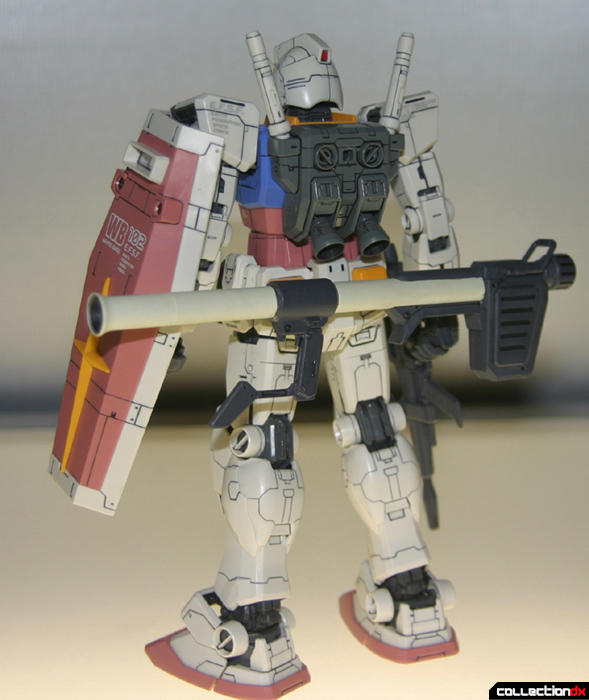
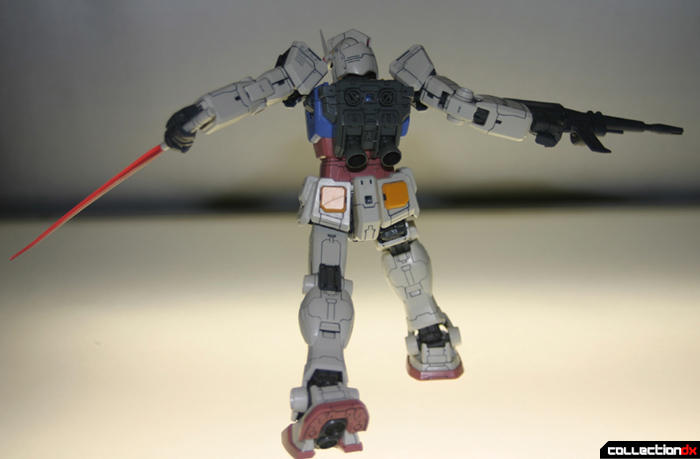
The outer armor for the torso is made of five primary parts and its detailed components. The Primary pieces are two collar-like parts for the midsection which fit around and lock onto the inner skeleton, and the chest armor which are front and back skins. The detail parts include the collar of the chest and the front hatch as well as the exhaust vents. As an extra step in value, the exhaust vents on the front of the chest are hinged. This is a nice change from the previous RX-78-2 kits where the front vents are typically single pieces with gashes to see through to the inner frame that are molded into their frame. The Gundam’s rear thruster pack is another example of Bandai simplifying construction with a single body piece to make up its inner body with the necessary parts for the Beam Saber docks and thruster swivels as the only assembly work. This is then covered by the backpack’s housing.

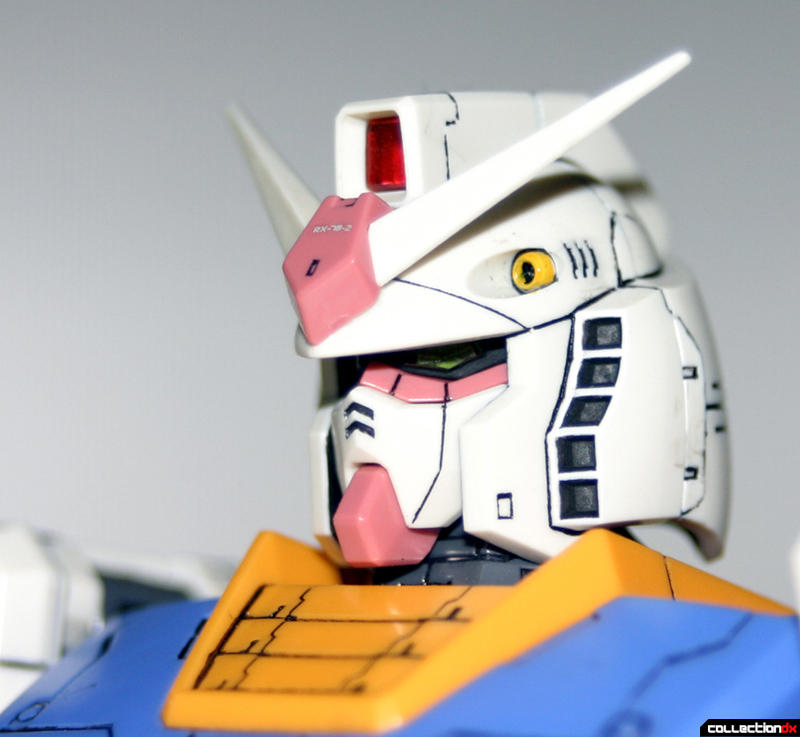
The head of the Version OYW has the most common with its RX-78-2 relatives in terms of assembly. The head is comprised of the eight parts, the face plate, chin/nose arch, optics (normal eyes, forehead optic), the “V” crest and its locking piece, and the front and back halves that make the head. As always, the head is connected to the body by a swiveling cup polycap. Although standard in construction, the details are remarkably tight, with etched details continuing the armor plating look. There is some paint work needed here for the barrels of the forehead mounted guns. There are some grievances here, as the head is connected to the runner at an area that seems like extra flack plastic, but that is not the case, as that area is meant to be a raised panel. If cautionary steps are taken, this can be done neatly and without ruining this added detail.
The Waist of the Version OYW features one of the latest additions to Master Grade engineering with the adjustable hinge line frame for the legs. This single molded piece is sandwiched between the two components in the waist that connects the waist into the torso (which also mounts the side skirts), can shift forward and back on its guide frame. This works to compliment the model’s posture to push the legs forward more when in a lunged kneeling posture to push the legs out further than the skirt armor. This new piece, although a great addition, has some minor frustrations attached. Because of the legs being attached to the hips via ball-cup polycaps, these caps tend to hold tight and the tension has a tendency to pull the hinge while performing even the slightest rotation.

Gundam’s skirt armor remains as close to the source as it has ever done. Bandai did another good job in keeping the details on the exterior matching the integral lining of the rest of the body. While the side skirts are simply hinged on a polycap cup, the four main skirts are articulated via a ball socket that is locked under the main body housing (crotch and central rear armor). This adds a much wider range of articulation, allowing the legs to rotate further back, and to some degree out to the side. Sideways articulation is limited due to the construction of the legs.
On the matter of the legs, Bandai opted to simplify their work load by reusing a set of parts from their second attempt at the RX-78-2 Gundam. Version 1.5 was produced after Bandai’s introduction of the Perfect Grade line and was a testament of their progression in Master Grade technology. By a process of double injection similar to their original System Injection molding, articulated parts could literally be assembled on the runner. The end result was first used in Perfect Grades for joint pistons and fingers. Continuing the same process, Bandai’s technique evolved from simple double runs (first layer finger tip and joint, second layer the conjoining knuckle) to the entirely complex. As such, the prefabricated leg was born, some assembly still required.
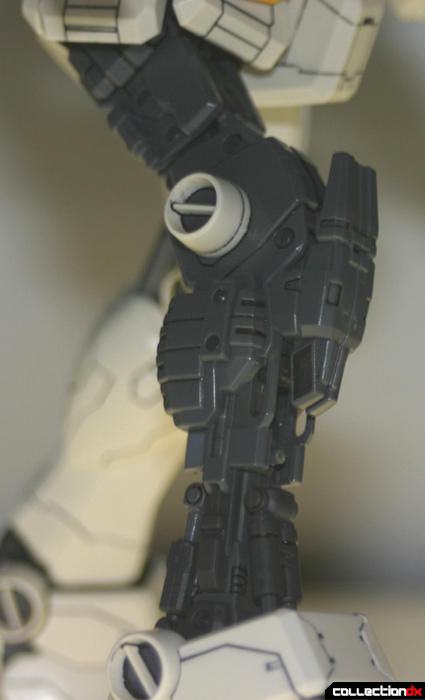
The prefabricated assembly resolves some of the minor technical issues of creating a balanced and functioning system of piston joints in the leg. The bare leg parts are molded with the needed pistons at the knee and ankle regions pre assembled and floating at their hinge points. Also present are a set of floating hinges for opening panels in the armor. At this stage, the leg is only half built and requires more assembly with the needed parts. These parts consist of the upper thigh which holds the polycap socket to connect it to the hips (also acting as the track for the upper knee joint), the outer knee covering, and the upper calf armor which locks into the lower knee pistons. The knee armor is the real locking point of the assembly, reinforced by screws to adjust tension. This screw is hidden beneath the joint cap armor. The final product is one of the most solid constructs in the entire kit.
Although the legs are built with the internal mechanism from the Version 1.5, Version OYW has an entirely new skin, with armor plating that fits the motif of the design’s integral look. The floating hinges I mentioned with the prefabricated leg connect to armor plating on the back of the leg that can open and expose parts. However these parts are fickle and tend to fall off when the hinges are open. There are some minor changes with an additional component at the ankle. The ankle armor of the Gundam is executed by three parts, segmented at the panel markings which are then held in place by a “Y” shaped guide rod with a ball stem. This stem is then built into the heel of the main foot assembly. This adds a delicate, refined touch that continues the separation of Version OYW and its RX-78-2 relatives on which this armor is just hinged at the ankle where it houses the ankle’s ball joint. Another difference is in the feet, where Bandai’s advancements in articulation have allowed the design of a hinge assemble at the toe to allow the foot to rotate forward and curl backwards. Although the legs are built with an old assembly, the minor difference in the Version OYW armor’s plating breathes new life into the process.
The arms are a compliment to the legs and armor design of the entire kit. Using a simplified method for an endoskeleton, the arms are built around the elbow, a sandwich assembly that holds the forearm and bicep in place (this is locked by an elbow plate on the back). Polycap sleeves set in place to hold the wrists and connect the arms to the shoulders. The shoulders are a series of plates holding a sleeve, which connect it to the shoulder stem. Starting at the shoulder, the primary armor is a set of plates, two making the top section (exterior armor, and underlying vent), back plate and the front plate. Additionally there is a hinge plate which connects to the inside of the front and back plates. This plate has a sleeve hole, allowing it to be held in place on the stem that connects the arm to the torso. The bicep armor is split and fits to the sides of the arm with the elbow ‘joint cap’ molded into it. The forearms armor is done using a shortcut technique of sleeves, often reserved for the bicep armor but easily translated for the forearm. The sleeves are two parts, the upper section below the elbow, and the main body. Locking the armor in place is the wrist plate, which also helps in hiding the polycap socket.

From experience, hands in a Master Grade kit have always had that air of frustration. For the longest time, Bandai’s use of hands have been limited to six piece assemblies, the thumb, index finger, and fingers sandwiched in a split palm and locked down by a backhand. The thumb, held by a ball socket whereas the fingers were simple hinges. The shifting thumb and loose tension in the finger hinges often left weapons falling out of the hand and greatly depreciating the display value. In Bandai’s first MSZ-006 Zeta Gundam Master Grade, they attempted to create a new set. This assembly used ball joints for all of the fingers and included hinge joint at the knuckles of the molded fingers (which were suspended by a single ball). While the idea might have been sound on paper, the practice was less than stellar in execution. The results suffered from a combination of loose joints and the same grievances of weapons not holding in place.
Making their debut with the Version OYW is the Master Grade version 2.0 Hands (their name given by fans and hobby enthusiasts). These hands sport a number of differences from the standard MG hands. The standard assembly has been upgraded, now a palm front and back hand pieces, a hinged ball joint for the wrist, and ball jointed fingers. The palm now has a protruding rail that is now used in locking weapons into the hand. The thumb and index finger of course are molded separate from the remaining fingers which are fused together. Unlike the Zeta attempt, the fused fingers have three corresponding balls for each digit, instead of just one. This introduces another “Bandai Extra Mile” technique for advanced building.

The Bandai Extra Mile is a technique that can range from extra clean up to making simple adjustments to parts that are typically molded as single pieces, from clearing excess tabs off the end of the Gundam “V” crests to splitting the skirt armor of a High Grade. For the Master Grade 2.0 Hands, this technique is incorporated into making the hands fully articulated. I learned about this from a Korean modelers’ resource site, and this prompted me to experiment. Due to the size and proximity with each ball joint, cutting them free from each other takes a very fine blade and steady hand. The reward however is something that can not be expressed in words, but in the end results. The fingers can now conform to the grip of a weapon, and the kit just looks that much better with the hands cut freely.
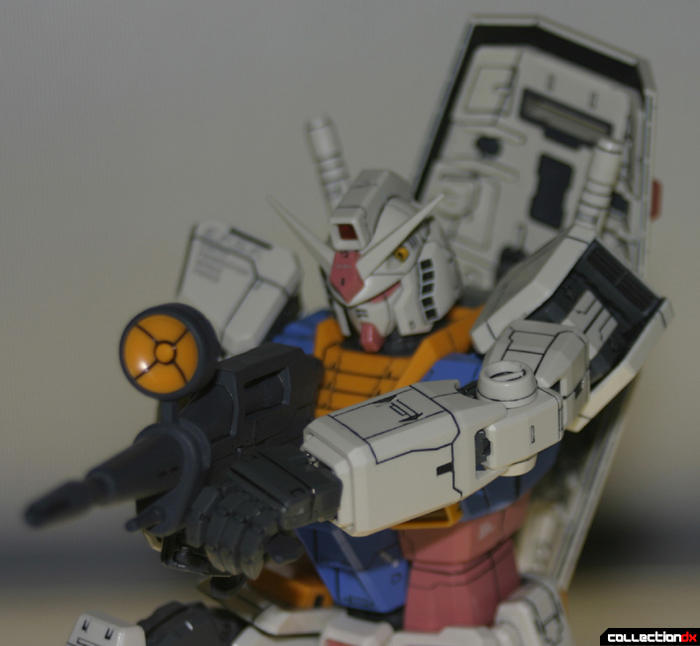
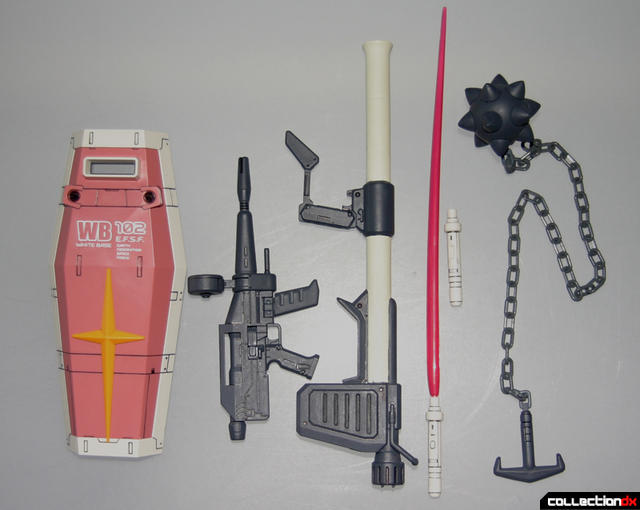
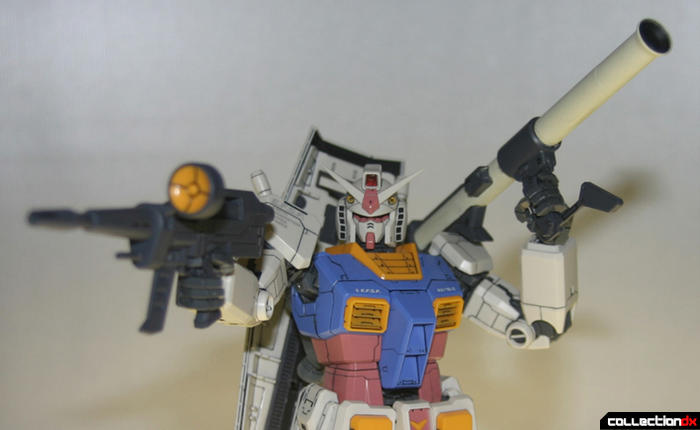
The Version OYW comes equipped for battle with the basics of the RX-78-2: its beam rifle, two beam sabers, shield, hyper bazooka, and the Gundamhammer. Complimenting the changes to the design and its new incorporation of the Version 2.0 hands, each weapon is fit with a groove to fit that mentioned palm-peg. This is a greatly appreciated inclusion especially for the sabers and rifle. Missing the groove however is the Gundamhammer, whose entire construction is comprised of RX-78-2 Version 1.5 parts.

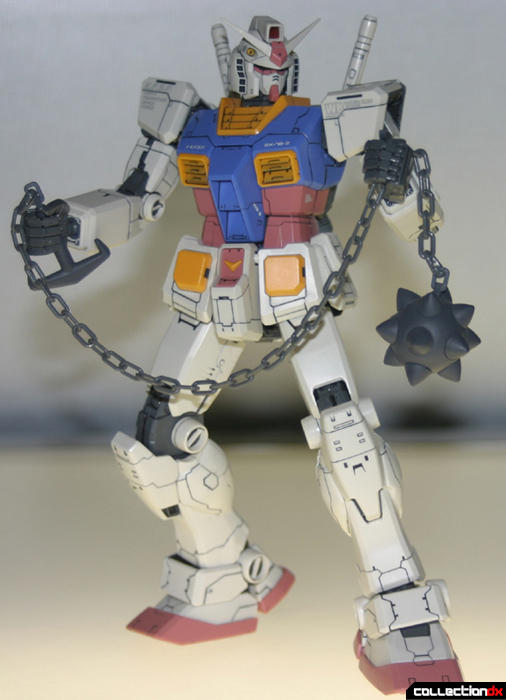
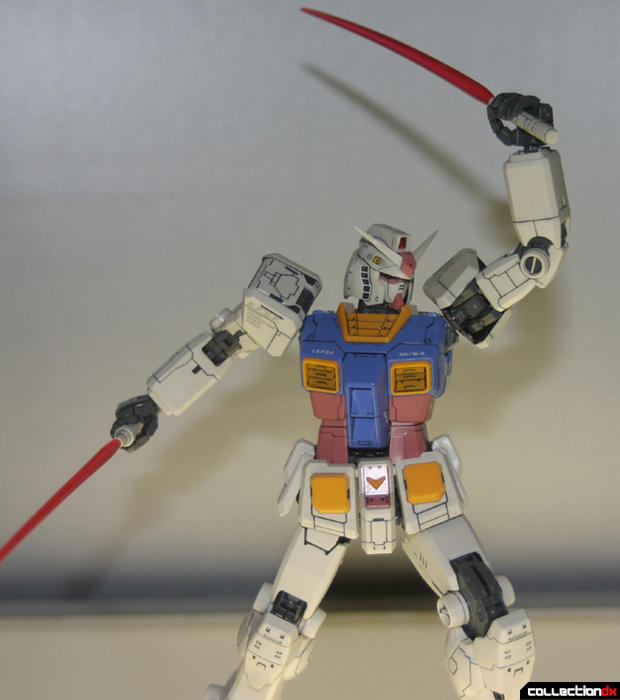
The Gundamhammer is a spiked mace suspended on a chain, and is a very popular weapon of the Gundam. Done to scale, the hammer is suspended on a pre assembled (eight inch) plastic chain and connects to the handle and mace ball via slip rings. The mace ball itself is an example of repetitive construction with each of the 14 spikes needing to be cut and placed into grooves of the ball (which in itself is composed of two separate halves). When finished the hammer is a fun addition to the classic design. The additional melee weapons of the Version OYW are the Gundam’s trademark pair of beam sabers. With both of the sabers molded in solid pieces, they require only cleaning and detailing before being applied to the model. As for the saber beams, Bandai gave the Version OYW a set of curved blades, a much more accented beam than the typical MG “tube” beams. Missing in action however is the Gundam’s beam javelin, but between the hammer and the projectile weapons this weapon is easily forgotten.
The shield, beam rifle, and hyper bazooka are all reinvented classics for the Version OYW. The shield, while molded in entirely new parts, reflects greatly on the original look of the design. The main viewport has a clear plastic window that needs painting to hide it into the backside of the shield. The shield’s grip is mounted on a snap clip that holds it into place on the arm, but when the grip is rotated it reveals a secondary peg that can attach the shield to the Gundam’s backpack. The main grip component piece is mounted to the shield via ports in the track rail on the interior. While this might seem like a lazy, last minute detail, the shield really doesn’t need to be adjusted to any of its other ports when posed in hand.
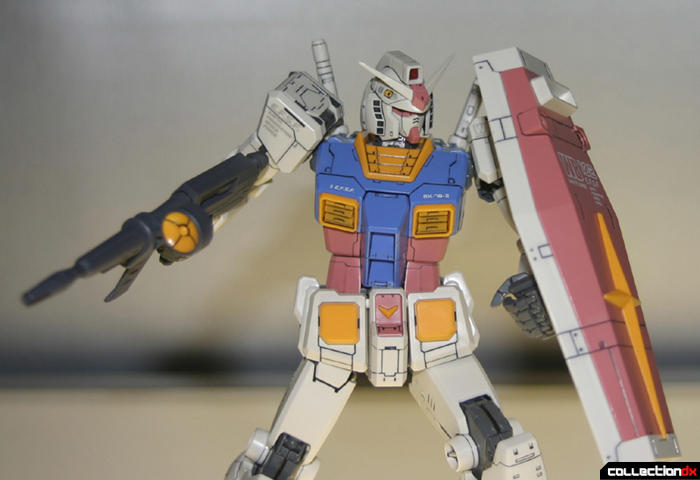
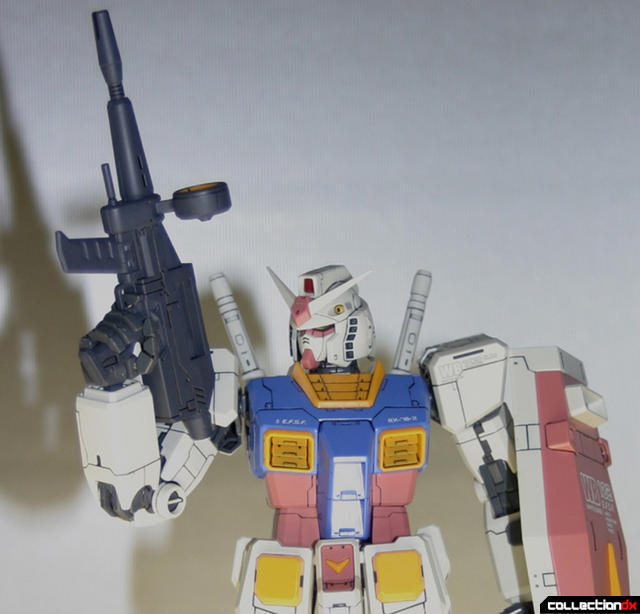
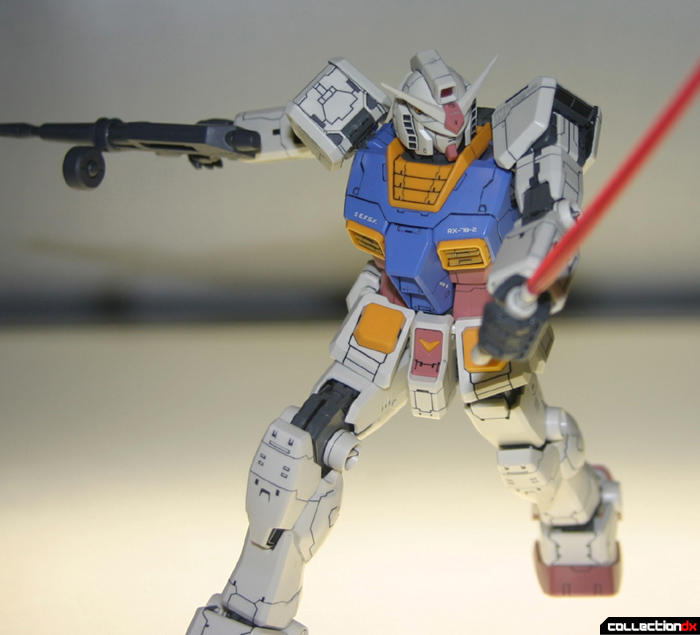
Gundam’s beam rifle returns as its primary weapon, but features a few differences to its history. The overall look of the rifle remains unchanged, with minor changes to the exterior look to compliment the panel marks of the model it is included with, and very subtle changes such as its length and height when compared to its relatives. The scope eye and the forward balancing grip are of course hinged to move but there is also a swinging tab on the side of the gun that allows it to dock to ports mounted on the Gundam’s backpack, back skirt, and additional ports in the shield.
The hyper bazooka is the last of the Gundam’s reinvented weapons. While compared to the previous incarnations shows that little has been changed (except for Version KA which has a mounted scope), it was given the same port-tab like the beam rifle on the side of the weapon. Construction follows the rule of the rifle, split down the middle with an extended solid cut cap-barrel, and additional cap parts that hold the halves in place and add more detail. The biggest and only major gripe here is that the bazooka is molded in solid gray plastic, but requires being painted white. The drawback is the shade of white is somewhat bleached and mixing the right tones can often backfire. Having painted mine, I can say that was the biggest fault on my part. Still, the bazooka is a welcome addition, and makes for some exceptional display poses complimented by the OYW design.

FLY GUNDAM!
Simply put, the Version OYW RX-78-2 Gundam is a nice reminder of the design’s importance to its legacy. It introduced the world to the Gundam and Bandai continues to use it as the test bed for introducing new and exciting changes in the world of Master Grade models. As stated earlier, those not enthused by the default Version OYW color scheme will most likely want to go for the later released “Anime Accurate” edition. In either case, this model was well worth the time and building.






| Posted 6 December, 2007 - 07:28 by Gunpla Rob |


